Barry Goldwater
Biography
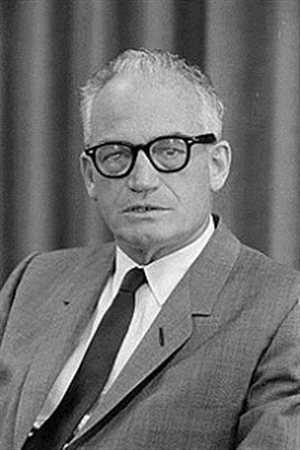
Barry Morris Goldwater (January 2, 1909 – May 29, 1998) Businessman and five-term United States Senator from Arizona (1953–1965, 1969–1987) and the Republican Party's nominee for President in the 1964 election. An articulate and charismatic figure during the first half of the 1960s, he was known as "Mr. Conservative". Goldwater is the politician most often credited for sparking the resurgence of the American conservative political movement in the 1960s. He also had a substantial impact on the libertarian movement. Goldwater rejected the legacy of the New Deal and fought through the conservative coalition to defeat the New Deal coalition. He mobilized a large conservative constituency to win the hard-fought Republican primaries. Goldwater's right-wing campaign platform ultimately failed to gain the support of the electorate[3] and he lost the 1964 presidential election to incumbent Democrat Lyndon B. Johnson by one of the largest landslides in history, bringing down many Republican candidates as well. The Johnson campaign and other critics painted him as a reactionary, while supporters praised his crusades against the Soviet Union, labor unions, and the welfare state. His defeat allowed Johnson and the Democrats in Congress to pass the Great Society programs, but the defeat of so many older Republicans in 1964 also cleared the way for a younger generation of American conservatives to mobilize. Goldwater was much less active as a national leader of conservatives after 1964; his supporters mostly rallied behind Ronald Reagan, who became governor of California in 1967 and the 40th President of the United States in 1981. Goldwater returned to the Senate in 1969, and specialized in defense policy, bringing to the table his experience as a senior officer in the Air Force Reserve. His greatest accomplishment was arguably the passage of the Goldwater-Nichols Act of 1986, which restructured the higher levels of the Pentagon by increasing the power of the Chairman of the Joint Chiefs of Staff to direct military action. In 1974, as an elder statesman of the party, Goldwater successfully urged President Richard Nixon to resign when evidence of a cover-up in the Watergate scandal became overwhelming and impeachment was imminent. By the 1980s, the increasing influence of the Christian right on the Republican Party so conflicted with Goldwater's libertarian views that he became a vocal opponent of the religious right on issues such as abortion, gay rights and the role of religion in public life. Goldwater was born in Phoenix, in what was then the Arizona Territory, the son of Baron M. Goldwater and his wife, Hattie Josephine ("JoJo") Williams. His father's Jewish family had founded Goldwater's, the largest department store in Phoenix. The family name had been changed from Goldwasser to Goldwater at least as early as the 1860 census in Los Angeles, California. Goldwater's paternal grandparents, Michel and Sarah (Nathan) Goldwasser, had been married in the Great Synagogue of London. Goldwater's mother, who was Protestant, came from an old Yankee family that included the famous theologian, Roger Williams of Rhode Island. Goldwater's parents were married in an Episcopal church in Phoenix; for his entire life, Goldwater was an Episcopalian, though on rare occasions he referred to himself as "Jewish".While he did not often attend church, he stated that "If a man acts in a religious way, an ethical way, then he's really a religious man—and it doesn't have a lot to do with how often he gets inside a church". The family department store made the Goldwaters comfortably wealthy. Goldwater graduated from Staunton Military Academy, an elite private school in Virginia, and attended the University of Arizona for one year, where he joined the Sigma Chi fraternity. Barry had never been close to his father, but he took over the family business after Baron's death in 1930. He became a Republican (in a heavily Democratic state), promoted innovative business practices, and opposed the New Deal, especially because it fostered labor unions. Goldwater came to know former president Herbert Hoover, whose conservative politics he admired greatly. In 1934, he married Margaret "Peggy" Johnson, wealthy daughter of a prominent industrialist from Muncie, Indiana. They had four children: Joanne (born January 1, 1936), Barry (born July 15, 1938), Michael (born March 15, 1940), and Peggy (born July 27, 1944). Barry became a widower in 1985, and in 1992 he married Susan Wechsler, a nurse 32 years his junior. With the American entry into World War II, Goldwater received a reserve commission in the United States Army Air Forces. He became a pilot assigned to the Ferry Command, a newly formed unit that flew aircraft and supplies to war zones worldwide. He spent most of the war flying between the USA and India, via the Azores and North Africa or South America, Nigeria, and Central Africa. He also flew "the hump" over the Himalayas to deliver supplies to the Republic of China. Remaining in the Air Force Reserve after the war, he eventually retired as a command pilot with the rank of Major General. By that time, he had flown 165 different types of aircraft. Following World War II, Goldwater was a leading proponent of creating the United States Air Force Academy, and later served on the Academy's Board of Visitors. The Visitor Center at the USAF Academy is now named in his honor. As a Colonel he also founded the Arizona Air National Guard, and he would desegregate it two years before the rest of the US military. Goldwater was instrumental in pushing the Pentagon to support desegregation of the armed services. Goldwater retired as an Air Force Major General, and he continued piloting B-52 aircraft until late in his military career. To those who called him "rash", he would remind people of the old saying that "there are no old, bold pilots". In 1940, Goldwater became one of the first people to run the Colorado River recreationally through Grand Canyon when he participated as an oarsman on Norman Nevills' second commercial river trip. Goldwater joined the trip in Green River, Utah and rowed his own boat down to Lake Mead. Goldwater ran track and cross country in high school, where he specialized in the 880 yard run. His parents strongly encouraged him to compete in these sports, to Goldwater's disdain. He often went by the nickname of "Rolling Thunder." In 1970, the Arizona Historical Foundation published the daily journal that Goldwater maintained on the Grand Canyon trip, along with the photographs he took, in a 209 page volume titled "Delightful Journey" by Barry Goldwater. Goldwater's son Barry Goldwater, Jr. served as a United States House of Representatives member from California from 1969 to 1983. Political career Goldwater entered Phoenix politics in 1949 when he was elected to the City Council as part of a nonpartisan group of candidates who focused on "cleaning up" widespread prostitution and gambling. As a Republican he won a seat in the US Senate in 1952, when he upset veteran Democrat and Senate majority leader Ernest McFarland. He defeated McFarland again in 1958, with a strong showing in his first reelection in a year in which the Democrats picked up 13 seats in the Senate. He stepped down from the Senate in 1964 for his presidential campaign. Policies Goldwater soon became most associated with labor-union reform and anti-communism; he was an active supporter of the conservative coalition in Congress. However, he rejected the wildest fringes of the anti-communist movement; in 1956, he sponsored the passage through the Senate of the final version of the Alaska Mental Health Enabling Act, despite vociferous opposition from opponents who claimed that the Act was a communist plot to establish concentration camps in Alaska. His work on labor issues led to Congress passing major anti-corruption reforms in 1957, and an all-out campaign by the AFL-CIO to defeat his 1958 reelection bid. He voted against the censure of Senator Joseph McCarthy in 1954, but he never actually charged any individual with being a communist/Soviet agent. Goldwater emphasized his strong opposition to the worldwide spread of communism in his 1960 book The Conscience of a Conservative. The book became an important reference text in conservative political circles. In 1964, Goldwater ran a conservative campaign that emphasized "states' rights". Goldwater's 1964 campaign was a magnet for conservatives since he opposed interference by the federal government in state affairs. Although he had supported all previous federal civil rights legislation and had supported the original senate version of the bill, Goldwater made the decision to oppose the Civil Rights Act of 1964. His stance was based on his view that the act was an intrusion of the federal government into the affairs of states and that the Act interfered with the rights of private persons to do or not do business with whomever they chose. All this appealed to white Southern Democrats, and Goldwater was the first Republican to win the electoral votes of the Deep South states (Louisiana, Georgia, Alabama, Mississippi, and South Carolina) since Reconstruction.] However, Goldwater's vote on the Civil Rights Act proved devastating to his campaign everywhere outside the South (besides Dixie, Goldwater won only in Arizona, his home state), contributing to his landslide defeat in 1964. While Goldwater had been depicted by his opponents in the Republican primaries as a representative of a conservative philosophy that was extreme and alien, his voting records show that his positions were in harmony with those of his fellow Republicans in the Congress. What distinguished him from his predecessors was, according to Hans J. Morgenthau, his firmness of principle and determination, which did not allow him to be content with mere rhetoric. Goldwater fought in 1971 to stop US funding of the United Nations after the People's Republic of China was admitted to the organization. He said: I suggested on the floor of the Senate today that we stop all funds for the United Nations. Now, what that'll do to the United Nations, I don't know. I have a hunch it would cause them to fold up, which would make me very happy at this particular point. I think if this happens, they can well move their headquarters to Peking or Moscow and get 'em out of this country." In 1964, he fought and won a bitterly contested, multi-candidate race for the Republican Party's presidential nomination. His main rival was New York Governor Nelson Rockefeller, whom he defeated by a narrow margin in the bitterly fought California primary. His nomination was opposed by liberal Republicans, who thought Goldwater's demand for rollback, defeat of the Soviet Union, would foment a nuclear war. Goldwater lost to President Lyndon Johnson by a massive landslide, pulling down the GOP, which lost many seats in both houses of Congress. Goldwater carried only his home state and five Deep South states. Goldwater remained popular in Arizona, and in the 1968 Senate election he was elected (this time) to the seat of retiring Senator Carl Hayden. He was subsequently reelected in 1974 and 1980. The 1974 election saw Goldwater easily reelected. His final campaign in 1980 was close, with Goldwater winning in a near draw against Democratic challenger Bill Schulz. Goldwater said later that the close result convinced him not to run again. Two self-published books advanced the Goldwater cause: A Choice, Not An Echo by Phyllis Schlafly and A Texan Looks at Lyndon: A Study in Illegitimate Power by the Texas historian J. Evetts Haley. Both were best-sellers but failed to bolster Goldwater's electoral prospects. Goldwater seriously considered retirement in 1980 before deciding to run for reelection. Peggy Goldwater reportedly hoped that her husband's Senate term, due to end in January 1981, would be his last. Goldwater decided to run, planning to make the term his last in the Senate. Goldwater faced a surprisingly tough battle for reelection. He was viewed by some as out of touch and vulnerable for several reasons; most importantly, because he had planned to retire in 1981, Goldwater had not visited many areas of Arizona outside of Phoenix and Tucson. He was also challenged by a formidable opponent, Bill Schulz, a former Republican turned Democrat and a wealthy real estate developer. Schulz was able to infuse massive amounts of money into the campaign from his own fortune. Arizona's changing population also hurt Goldwater. The state's population had soared, and a huge portion of the electorate had not lived in the state when Goldwater was previously elected; hence, many voters were less familiar with Goldwater's actual beliefs, and he was on the defensive for much of the campaign. Early returns on election night seemed to indicate that Schulz would win. The counting of votes continued through the night and into the next morning. At around daybreak, Goldwater learned that he had been reelected thanks to absentee ballots, which were among the last to be counted. Goldwater's surprisingly close victory in 1980 came despite Reagan's 61% landslide over Jimmy Carter in Arizona. Republicans regained control of the Senate, putting Goldwater in the most powerful position he ever had in the Senate. Goldwater retired in 1987, serving as chair of the Senate Intelligence and Armed Services Committees in his final term. Despite his reputation as a firebrand in the 1960s, by the end of his career he was considered a stabilizing influence in the Senate, one of the most respected members of either major party. Though Goldwater remained staunchly anti-communist and "hawkish" on military issues, he was a key supporter of the fight for ratification of the Panama Canal Treaty in the 1970s, which would return control of the canal zone to the Republic of Panama. His most important legislative achievement may have been the Goldwater-Nichols Act, which reorganized the US military's senior-command structure. Goldwater was an active amateur radio "ham" operator, with call letters K7UGA. Many hams were delighted to make contact with him in his retirement years. Goldwater was grief-stricken by the assassination of Kennedy and was greatly disappointed that his opponent in the 1964 race would not be Kennedy but instead Kennedy's Vice President, the former Senate Majority Leader Lyndon B. Johnson of Texas. Goldwater disliked Johnson (who he said "used every dirty trick in the bag"), and Richard M. Nixon of California (whom he later called "the most dishonest individual I have ever met in my life"). Goldwater, by then again a senator, advocated for Nixon to resign at the height of Watergate, warning that fewer than ten senators would vote against conviction after Nixon was impeached by the House of Representatives. The term "Goldwater moment" has subsequently been used to describe situations when influential members of Congress disagree so strongly with a president from their own party that they rise up and take a stand against him. His 1984 Cable Franchise Policy and Communications Act allowed local governments to require the transmission of public, educational, and government access (PEG) channels, barred cable operators from exercising editorial control over content of programs carried on PEG channels, and absolved them from liability for their content. U.S. presidential campaign, 1964 At the time of Goldwater's presidential candidacy, the Republican Party was split between its conservative wing (based in the West and South) and moderate/liberal wing (based in the Northeast). He alarmed even some of his fellow partisans with his brand of staunch fiscal conservatism and militant anti-communism. He was viewed by many traditional Republicans as being too far on the right wing of the political spectrum to appeal to the mainstream majority necessary to win a national election. As a result, moderate Republicans recruited a series of opponents, including New York Governor Nelson Rockefeller, Henry Cabot Lodge, Jr., of Massachusetts and Pennsylvania Governor William Scranton, to challenge Goldwater. Goldwater would defeat Rockefeller in the winner-take-all California primary and secure the nomination. He also had a solid backing from Southern Republicans. A bright young Birmingham lawyer, John Grenier, secured commitments from 271 of 279 southern convention delegates to back Goldwater. Grenier went on to serve as executive director of the national GOP during the Goldwater campaign. This was the Number 2 position to party chairman Dean Burch, Goldwater's fellow Arizonan. Goldwater famously declared in his bold acceptance speech at the 1964 Republican Convention: "I would remind you that extremism in the defense of liberty is no vice. And let me remind you also that moderation in the pursuit of justice is no virtue." This paraphrase of Cicero was included at the suggestion of Harry V. Jaffa, though the speech was primarily written by Karl Hess. Due to President Johnson's popularity, however, Goldwater held back from attacking the president directly; he did not even mention Johnson by name in his convention speech. Past comments came back to haunt Goldwater throughout his campaign. Once he called the Eisenhower administration "a dime-store New Deal," and the former president never fully forgave him. Eisenhower did, however, film a TV commercial with Goldwater. Eisenhower qualified his voting for Goldwater in November by remarking that he had voted not specifically for Goldwater, but for the Republican Party.[citation needed] In December 1961, Goldwater told a news conference that "sometimes I think this country would be better off if we could just saw off the Eastern Seaboard and let it float out to sea". That comment boomeranged on him during the campaign in the form of a Johnson television commercial, as did remarks about making Social Security voluntary, and statements in Tennessee about selling the Tennessee Valley Authority, a large local New Deal employer. The Goldwater campaign spotlighted Ronald Reagan, who appeared in a campaign ad. In turn, Reagan gave a stirring, nationally televised speech, "A Time for Choosing", in support of Goldwater. The speech prompted Reagan to seek the California Governorship in 1966 and jump-started his political career. Conservative activist Phyllis Schlafly, later well known for her fight against the Equal Rights Amendment, first became known for writing a pro-Goldwater book, A Choice, Not an Echo, attacking the moderate Republican establishment. Senator Prescott Bush (1895–1972), a moderate Republican from Connecticut, was a friend of Goldwater and supported him in the general election campaign. Bush's son, George H. W. Bush (then running for the Senate from Texas against Democrat Ralph Yarborough), was also a strong Goldwater supporter in both the nomination and general election campaigns. Future Chief Justice of the Supreme Court and fellow Arizonan William Rehnquist also first came to the attention of national Republicans through his work as a legal adviser to Goldwater's 1964 campaign. Goldwater was painted as a dangerous figure by the Johnson campaign, which countered Goldwater's slogan "In your heart, you know he's right" with the lines "In your guts, you know he's nuts," and "In your heart, you know he might" (that is, he might actually use nuclear weapons as opposed to using only deterrence). Johnson himself did not mention Goldwater in his own acceptance speech at the 1964 Democratic National Convention. Goldwater's provocative advocacy of aggressive tactics to prevent the spread of communism in Asia led to effective counterattacks from Lyndon B. Johnson and his supporters, who claimed that Goldwater's militancy would have dire consequences, possibly even nuclear war. In a May 1964 speech, Goldwater suggested that nuclear weapons should be treated more like conventional weapons and used in Vietnam, specifically that they should have been used at Dien Bien Phu in 1954 to defoliate trees. Regarding Vietnam, Goldwater charged that Johnson's policy was devoid of "goal, course, or purpose," leaving "only sudden death in the jungles and the slow strangulation of freedom."Goldwater's rhetoric on nuclear war was viewed by many as quite uncompromising, a view buttressed by off-hand comments: "Let's lob one into the men's room at the Kremlin" is an example. He also advocated that field commanders in Vietnam and Europe should be given the authority to use tactical nuclear weapons (which he called "small conventional nuclear weapons") without presidential confirmation. Goldwater did his best to counter the Johnson attacks, criticizing the Johnson administration for its perceived ethical lapses, and stating in a commercial that "we, as a nation, are not far from the kind of moral decay that has brought on the fall of other nations and people.... I say it is time to put conscience back in government. And by good example, put it back in all walks of American life." Goldwater campaign commercials included statements of support by actor Raymond Massey and moderate Republican senator Margaret Chase Smith. Before the 1964 election, the muckraking Fact magazine, published by Ralph Ginzburg, ran a special issue entitled ‘The Unconscious of a Conservative: A Special Issue on the Mind of Barry Goldwater.’ The two main articles contended that Goldwater was mentally unfit to be president. The magazine attempted to support this claim with the results of an unscientific poll of psychiatrists it had conducted. Fact had mailed questionnaires to 12,356 psychiatrists, and published a ‘sampling’ of the comments made by the 2,417 psychiatrists who responded, of which 1,189 said Goldwater was unfit to be president. After the election, Goldwater sued the publisher, the editor and the magazine for libel in Goldwater v. Ginzburg. "Although the jury awarded Goldwater only $1.00 in compensatory damages against all three defendants, it went on to [396 U.S. 1049, 1050] award him punitive damages of $25,000 against Ginzburg and $50,000 against Fact magazine, Inc. "According to Warren Boroson, then-managing editor of Fact and now a financial columnist, the main biography of Goldwater in the magazine was written by David Bar-Illan, the Israeli pianist. A Democratic campaign advertisement known as Daisy showed a young girl counting daisy petals, from one to ten. Immediately following this scene, a voiceover counted down from ten to one. The child's face was shown as a still photograph followed by images of nuclear explosions and mushroom clouds. The campaign advertisement ended with a plea to vote for Johnson, implying that Goldwater (who was not mentioned by name) would provoke a nuclear war if he was elected. The advertisement, which featured only a few spoken words of narrative and relied on imagery for its emotional impact, was one of the most provocative in American political campaign history, and many analysts credit it as being the birth of the modern style of "negative political ads" on television. The ad aired only once and was immediately pulled but was then shown many times by television stations. Goldwater only won his home state of Arizona and five states in the Deep South, depicted in red. The Southern states, traditionally Democratic up to that time, voted Republican primarily as a statement of opposition to the Civil Rights Act, which had been passed by Johnson and the Democrats in Congress earlier that year. In the end, Goldwater received 38.4% of the popular vote, and carried six states: Arizona (with only 50.45% of the popular vote) and the core states of the Deep South: Alabama, Georgia, Louisiana, Mississippi, and South Carolina, where for the last time the electorate was practically all white. In all, Johnson won an overwhelming 486 electoral votes, to Goldwater's 52. Goldwater, with his customary bluntness, remarked: "We would have lost even if Abraham Lincoln had come back and campaigned with us." He maintained later in life that he would have won the election if the country had not been in a state of extended grief (referring to the assassination of John F. Kennedy), and that it was simply not ready for a third President in just 14 months. Goldwater's poor showing pulled down many supporters. Of the 57 Republican Congressmen who endorsed Goldwater before the convention, 20 were defeated for reelection, along with many promising young Republicans. On the other hand, the defeat of so many older politicians created openings for young conservatives to move up the ladder. While the loss of moderate Republicans was temporary—they were back by 1966—Goldwater also permanently pulled many conservative Southerners and white ethnics out of the New Deal Coalition. "In the South, Goldwater broke through and won five states—the best showing in the region for a GOP candidate since Reconstruction. In Mississippi — where Franklin D. Roosevelt had won nearly 100 percent of the vote just 28 years earlier — Goldwater claimed a staggering 87 percent." It has frequently been argued that Goldwater's strong performance in Southern states previously regarded as Democratic strongholds foreshadowed a larger shift in electoral trends in the coming decades that would make the south a Republican bastion (an end to the "Solid South")—first in presidential politics and eventually at the congressional and state levels, as well. Although Goldwater was not as important in the American conservative movement as Ronald Reagan after 1965, he shaped and redefined the movement from the late 1950s to 1964. Arizona Senator John McCain, who had succeeded Goldwater in the Senate in 1987, summed up Goldwater's legacy, "He transformed the Republican Party from an Eastern elitist organization to the breeding ground for the election of Ronald Reagan. "Columnist George Will remarked after the 1980 Presidential election that it took 16 years to count the votes from 1964 and Goldwater won. The Republican Party recovered from the 1964 election debacle, picking up 47 seats in the House of Representatives in the 1966 mid-term election. Further Republican successes ensued, including Goldwater's return to the Senate in 1968. In January of that year, Goldwater wrote an article in the National Review "affirming that he [was] not against liberals, that liberals are needed as a counterweight to conservatism, and that he had in mind a fine liberal like Max Lerner". Goldwater was a strong supporter of the environment. He explained his position in 1969: I feel very definitely that the [Nixon] administration is absolutely correct in cracking down on companies and corporations and municipalities that continue to pollute the nation's air and water. While I am a great believer in the free competitive enterprise system and all that it entails, I am an even stronger believer in the right of our people to live in a clean and pollution-free environment. To this end, it is my belief that when pollution is found, it should be halted at the source, even if this requires stringent government action against important segments of our national economy. Throughout the 1970s, as the conservative wing under Reagan gained control of the party, Goldwater concentrated on his Senate duties, especially in military affairs. He played little part in the election or administration of Richard Nixon, but he helped force Nixon's resignation in 1974. In 1976 he helped block Rockefeller's renomination as vice president. When Reagan challenged Ford for the presidential nomination in 1976, Goldwater endorsed Ford, looking for consensus rather than conservative idealism. As one historian notes, "The Arizonan had lost much of his zest for battle." In 1979, when President Carter normalized relations with Communist China, Goldwater and some other senators sued him in the Supreme Court, arguing that the president could not terminate the Sino-American Mutual Defense Treaty with Republic of China (Taiwan) without the approval of Congress. The case, Goldwater v. Carter, was dismissed by the court as a political question. By the 1980s, with Ronald Reagan as president and the growing involvement of the religious right in conservative politics, Goldwater's libertarian views on personal issues were revealed; he believed that they were an integral part of true conservatism. Goldwater viewed abortion as a matter of personal choice, not intended for government intervention. As a passionate defender of personal liberty, he saw the religious right's views as an encroachment on personal privacy and individual liberties. In his 1980 Senate reelection campaign, Goldwater won support from religious conservatives but in his final term voted consistently to uphold legalized abortion and, in 1981, gave a speech on how he was angry about the bullying of American politicians by religious organizations, and would "fight them every step of the way". Goldwater also disagreed with the Reagan administration on certain aspects of foreign policy (for example, he opposed the decision to mine Nicaraguan harbors). Notwithstanding his prior differences with Dwight D. Eisenhower, Goldwater in a 1986 interview rated him the best of the seven Presidents with whom he had worked. On May 12, 1986, Goldwater was presented with the Presidential Medal of Freedom by President Ronald Reagan. After his retirement in 1987, Goldwater described the Arizona Governor Evan Mecham as "hardheaded" and called on him to resign, and two years later stated that the Republican party had been taken over by a "bunch of kooks". He is a 1987 recipient of the Langley Gold Medal from the Smithsonian Institution. In 1988, in recognition of his career, Princeton University's American Whig-Cliosophic Society awarded Goldwater the James Madison Award for Distinguished Public Service. In a 1994 interview with the Washington Post the retired senator said, When you say "radical right" today, I think of these moneymaking ventures by fellows like Pat Robertson and others who are trying to take the Republican party and make a religious organization out of it. If that ever happens, kiss politics goodbye. Goldwater visited the small town of Bowen, Illinois in 1989 to see first hand where his mother was raised.
The Fog of War
Himself (archive footage) (uncredited)
Watergate: High Crimes in the White House
Self

Battle for Disclosure
Self - Senator from Arizona

Best of Enemies: Buckley vs. Vidal
Self
All the Way
Himself (archive footage)
Dick
Himself (at 1972 Convention) (archive footage) (uncredited)
Rumor Has It...
Himself (archive footage) (uncredited)
Battle for Disclosure
Self - Senator from Arizona
Watergate: High Crimes in the White House
Self
All the Way
Himself (archive footage)
Best of Enemies: Buckley vs. Vidal
Self
Rumor Has It...
Himself (archive footage) (uncredited)
The Fog of War
Himself (archive footage) (uncredited)
Dick
Himself (at 1972 Convention) (archive footage) (uncredited)


