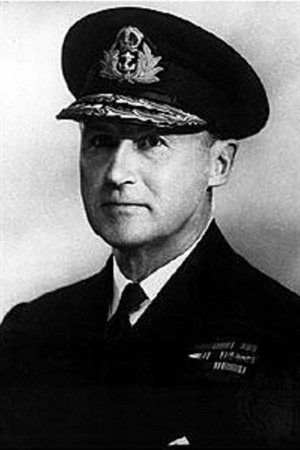
Bertram Ramsay
Biography
Admiral Sir Bertram Home Ramsay KCB, KBE, MVO (20 January 1883 – 2 January 1945) was a British admiral during World War II. He was an important contributor in the field of amphibious warfare. He was born in London, into an old Scottish family (see Ramsay Baronets), and attended Colchester Royal Grammar School. In 1898, he joined the Royal Navy. Serving on HMS Britannia, he became a midshipman within a year. Following his promotion, he was transferred to HMS Crescent. World War I During World War I he was assigned his first command, the "M 25", a small monitor, in August 1915. For two years his ship was part of the Dover Patrol off the Belgian coast. On October 1917 he took command of another Dover Patrol vessel, the destroyer HMS Broke. On 9 May 1918, his ship took part in the Second Ostend Raid, a follow up to the Zeebrugge Raid, and he was mentioned in despatches. Resigning from the Navy in 1938, he was coaxed out of retirement by Winston Churchill one year later to help deal with the Axis threat. World War II Promoted to Vice-Admiral, he was placed in charge of the Dover area of operations on 24 August 1939. His duties included overseeing the defence against possible destroyer raids, protection of cross-Channel military traffic and the denial of the passage through the Straits of Dover to submarines. As Vice-Admiral Dover he was responsible for the Dunkirk evacuation, codenamed Operation Dynamo. Working from the underground tunnels beneath Dover Castle, he and his staff worked for nine days straight to rescue troops trapped in France by the German forces. For his success in bringing home 338,226 British and allied soldiers from the beaches of Dunkirk, he was asked to personally report on the operation to the King and was made a Knight Commander of the Order of the Bath. After Operation Dynamo was completed, he was faced with the enormous problems of defending the waters off Dover from the expected German invasion. For nearly two years, he commanded forces striving to maintain control against the Germans, gaining a second Mention in Despatches. Ramsay was to be appointed as Naval Force Commander for the invasion of Europe on 29 April 1942, but the invasion was postponed and he was transferred to become deputy Naval commander of the Allied invasion of North Africa. Under the Allied Naval Commander of the Expeditionary Force, Sir Andrew Cunningham, Ramsay planned the landing efforts. During the Allied invasion of Sicily in July 1943, he was Naval Commanding Officer, Eastern Task Force and prepared the amphibious landings. He was re-instated on the Active List on 26 April 1944 and promoted to the rank of Admiral on 27 April 1944. Although the men fighting on the beaches of Normandy on D-Day richly deserve the attention given to their efforts, the job of the naval forces was also of vital importance. In 1944, Ramsay was appointed Naval Commander in Chief of the Allied Naval Expeditionary Force for the invasion. On 2 January 1945, he was killed when his plane crashed on takeoff at Toussus-le-Noble, southwest of Paris. He was en route to a conference with General Bernard Montgomery in Brussels. A memorial to all who died in the crash was erected at Toussus-le-Noble in May 1993; photographs of the memorial can be seen here. Ramsay will always be remembered for his planning in the Dover Wartime tunnels of Operation Dynamo. His dedication to his country will always be remembered. A statue of Ramsay was erected in November 2000 at Dover Castle, close to where he had planned the Dunkirk evacuation. His involvement in the Dunkirk evacuation and D-Day landings has led to several appearances as a character in film and television drama - in The Longest Day (1962, played by John Robinson), Churchill and the Generals (1979, played by Noel Johnson), Dunkirk (2004, played by Richard Bremmer) and Ike: Countdown to D-Day (2004, played by Kevin J. Wilson). His name was also recently added onto the Colchester Royal Grammar School war memorial, along with other Old Colcestrians who had been omitted. A portrait is also to be put up in the school.